

Transparency International – Corruption Perceptions Index 2025 and Implications for Companies Operating in Türkiye
The CPI 2025 highlights continued global governance decline, with Türkiye ranking 124th out of 182 countries and recording its lowest score to date. This environment increases regulatory, reputational, and compliance risks for companies. Businesses operating in Türkiye must strengthen internal controls, third-party due diligence, and governance frameworks to meet rising international enforcement and investor expectations.
11.02.2026
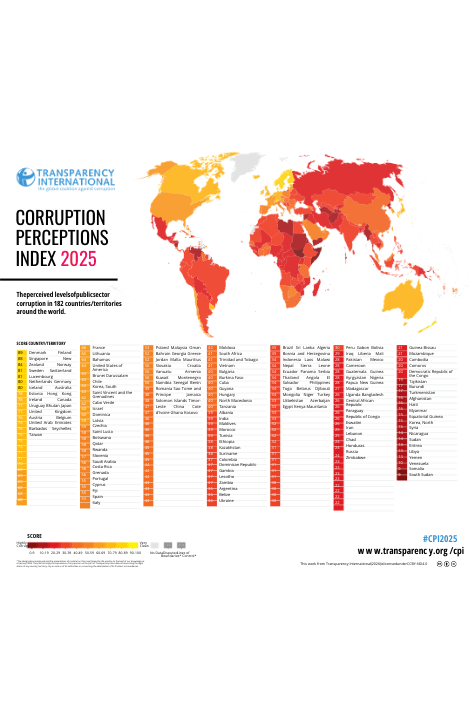
Transparency International’s (“TI”) Corruption Perceptions Index (“CPI”), which is published annually, assesses perceived public-sector corruption in 182 countries and territories based on data from 13 independent sources. The latest 2025 edition, recently published by TI, indicates a continued global decline in governance standards, with the global average score falling to 42 and 122 countries scoring below 50. Also, since 2012, 31 countries improved, 50 countries declined and 100 countries stayed the same.
Global Overview
The CPI ranks Denmark (89) first for the eighth consecutive year, followed by Finland (88) and Singapore (84). At the other end of the spectrum, Somalia (9), Venezuela (10), Yemen (13), and South Sudan (9) feature among the lowest-ranked countries in this year’s index. A limited set of 15 countries—primarily in Western Europe and the Asia-Pacific region—score above 75, and only five of them achieve scores exceeding 80, mainly in Western Europe and Asia-Pacific. The report also highlights deteriorating performance in several established democracies, demonstrating that corruption risks remain present even in traditionally strong institutional environments.
The report also notes a concerning decline among several democracies, with perceived corruption worsening in countries such as the United States (64), Canada (75) and New Zealand (81), as well as in parts of Europe including the United Kingdom (70), France (66) and Sweden (80). TI attributes this decline largely to weakened political leadership, democratic backsliding, and increasing restrictions on civic space. Countries that limit media freedom, civil society activity, and independent oversight are more likely to experience rising corruption risks. The report further emphasises that most journalists killed while investigating corruption operate in low-scoring countries, underlining the link between transparency and accountability.
Türkiye’s Position
Türkiye scored 31 in the 2025 CPI and ranks 124th out of 182 countries, placing it among the lowest-performing jurisdictions globally. This represents the lowest score in its CPI history and reflects a sustained downward trend over the past decade. Significantly, Türkiye's CPI score has seen a decline of 3 points since 2024, falling below the regional average of 34 for Eastern Europe and Central Asia and significantly lower than the global average.
The report associates declining scores with weakened institutional safeguards, politicisation of justice systems, reduced effectiveness of oversight bodies, and constraints on civic space. In Türkiye, increasing perceptions of corruption may affect regulatory predictability, public procurement processes, and confidence in administrative and judicial remedies. From a governance perspective, low CPI performance also signals risks to long-term economic stability, public trust, and the quality of public services. These factors may influence investment decisions and increase compliance-related scrutiny in cross-border transactions involving Türkiye.
Implications for Corporate Compliance Programs in Türkiye
Türkiye’s record-low CPI score carries significant implications for companies operating domestically or engaging in cross-border transactions involving Türkiye. While the CPI reflects perceptions of public-sector corruption rather than proven misconduct, lower scores typically translate into heightened compliance expectations from regulators, financial institutions, and international business partners.
1. Increased Third-Party Risk Exposure
Companies operating in lower-scoring jurisdictions face elevated risks in public procurement, licensing processes, customs interactions, and regulatory approvals. As a result, third-party intermediaries (agents, consultants, distributors) present heightened corruption exposure. Robust third-party due diligence, contractual safeguards, and ongoing monitoring become critical.
2. Enhanced Scrutiny Under Extraterritorial Anti-Corruption Laws
Multinational companies and Turkish entities with foreign shareholders may face increased exposure under laws such as:
- The U.S. Foreign Corrupt Practices Act (FCPA)
- The UK Bribery Act
- EU anti-money laundering and anti-corruption frameworks
Operating in a low-CPI environment may elevate enforcement agencies’ risk assessments and increase expectations for demonstrable “adequate procedures.”
3. Strengthened Internal Controls and Documentation
Where regulatory predictability is perceived as weaker, companies must compensate through stronger internal controls, including:
- Clear approval hierarchies for public-facing transactions
- Transparent documentation of interactions with public officials
- Segregation of duties and financial oversight
- Effective whistleblowing mechanisms
Documentation quality becomes particularly important in the event of cross-border investigations.
4. Board-Level Oversight and Tone at the Top
Increased corruption perception heightens the importance of governance culture. Boards of directors should:
- Receive periodic corruption risk assessments
- Oversee compliance KPIs
- Ensure independence of compliance functions
- Allocate sufficient compliance resources
Failure to implement credible oversight may expose directors to personal liability in certain jurisdictions.
5. Reputational and Investment Risk
International investors, ESG-focused funds, and financial institutions increasingly incorporate CPI metrics into country risk assessments. Lower scores may influence:
- Financing conditions
- Insurance premiums
- M&A due diligence intensity
- Valuation assumptions
Proactive compliance frameworks may therefore serve as a competitive differentiator.
Conclusion
The CPI 2025 confirms that corruption remains a major global governance challenge, driven by weakened leadership, democratic regression, and shrinking civic space. Türkiye’s record-low score highlights the urgent need for stronger institutional safeguards, enhanced transparency, and credible enforcement mechanisms.
For companies operating in Türkiye, CPI 2025 should be interpreted not only as a governance indicator but as a compliance signal. In lower-scoring environments, regulators, investors, and global counterparties expect stronger internal safeguards, enhanced transparency, and demonstrable commitment to ethical conduct.
You can read the full report here.
-
Kemal Altuğ Özgün
Managing Partner

-
Emire Özeyranlı
Associate

-
Onur Akar
Legal Trainee

Related Insights
Explore further resources, articles, and valuable perspectives that delve deeper into related topics, offering you a broader understanding.
-
 Article 27.07.2026
İş Yerinde Cinsel Taciz: Sessizliğin Hukuki ve Kurumsal Bedeli
İş yerinde cinsel taciz, çalışanların kişilik haklarını ve çalışma özgürlüğünü ihlal ederken işveren açısından hukuki, cezai ve itibari riskler doğurur. Etkili mücadele; açık politikalar, erişilebilir şikâyet kanalları, tarafsız iç soruşturma, delillerin korunması, misillemenin önlenmesi ve yöneticilerin eğitilmesini gerektirir. Global şirketlerde süreçler Türk hukukuna, yerel kültüre ve saha koşullarına uyarlanmalıdır. Böylece mağdurun güvenliği sağlanır, işveren sorumluluğunu yerine getirir ve kurumsal itibar korunur.
Read more > -
 Legal Alert 24.07.2026
AB için Son Yılların En Büyük Yaptırım Paketi: 21. Yaptırım Paketi ile Neler Değişti?
Avrupa Birliği, 23 Temmuz'da kabul edilen ve "son dört yılın en büyüğü" olarak nitelendirilen 21. Yaptırım Paketi ile Rusya’ya yönelik kısıtlama rejimini genişletmiştir. 21. Yaptırım Paketi; finans, enerji, kripto ve ticari sektör kısıtlamalarından gölge filoya katkı sunan üçüncü ülke aktörlerini de içeren 218 yeni listelemeye kadar geniş bir tedbir yelpazesi sunmaktadır. Özellikle, gölge filoya destek veren üçüncü ülke aktörleri ile üçüncü ülke kripto platformlarına yönelik ilk kez genişletilen yaptırım yetkileri ve AB şirketlerini misilleme davalarından koruyan yargı mekanizmaları dikkat çekmektedir.
Read more > -
 Article 22.07.2026
Türk Hukukunda İflas Talebi ve İflasın Ertelenmesi
Türk hukukunda iflas, borçlunun malvarlığının alacaklılar arasında eşitlik ilkesiyle topluca tasfiyesini sağlayan kolektif cebri icra yoludur. İflas talebi takipli veya kanunda sınırlı sayılan hâllerde doğrudan yapılabilmekte; alacaklı ya da borçlu tarafından ileri sürülebilmektedir. Borca batık şirketlere geçici koruma sağlayan iflasın ertelenmesi kurumu ise, kötüye kullanım ve alacaklıların yetersiz korunması nedeniyle 2018’de kaldırılmış, yerine konkordato daha etkin bir yeniden yapılandırma aracı olarak getirilmiştir.
Read more > -
 Legal Alert 08.07.2026
Türkiye Menşeli Sıcak Haddelenmiş Yassı Çelik Ürünlere Uygulanan Anti-Damping Önlemleri Gözden Geçiriliyor
Avrupa Komisyonu, Türkiye menşeli belirli sıcak haddelenmiş yassı çelik ürünlerine uygulanan anti-damping vergisine ilişkin gözden geçirme süreci başlatmıştır. İnceleme, mevcut önlemin kaldırılması halinde dampingin ve zararın devam edip etmeyeceğini değerlendirecektir. Türk üreticiler bakımından ilgili taraf kaydı, örnekleme süreci ve veri hazırlıklarının süresi içinde tamamlanması önem taşımaktadır.
Read more >