

Wearable Technology in the Workplace: The Boundaries by the Turkish Personal Data Protection Law
In the third article of our series on Employers’ Monitoring Activities in Light of the Law on the Protection of Personal Data, we examine wearable device technology in the workplace. While this technology offers opportunities in terms of productivity and occupational health and safety, it also entails risks for the right to privacy and the protection of personal data, as it requires the real-time and continuous monitoring of employees. Before using this technology, employers should concretely assess the purpose of the practice, its proportionality, and whether less intrusive alternatives are available. The current views of the Personal Data Protection Authority on widespread surveillance practices in the workplace also provide guidance on this issue.
03.07.2026
Wearable Devices
Wearable devices are electronic devices that are integrated into clothing or accessories or worn directly on or attached to the human body.[1] Each of these devices can be considered a mini-computer or a “smart” device. The software embedded in the device processes data collected through its built-in sensors. The data may be stored on the device in either raw or processed form or transmitted to a central system where it can be analyzed through a mobile application, depending on its intended purpose. Some devices are connected to cloud-based systems, enabling them to provide users with real-time feedback and/or execute predefined automated functions. Depending on the sensors they incorporate, these devices can collect and process various types of data, including the user’s step count, location, heart rate, body temperature, and other health-related information.[2]
Among wearable devices, smartwatches are the most widely used. Their most common application is in the healthcare sector, particularly for the real-time monitoring of specific health metrics of individuals with chronic conditions, such as blood pressure, respiratory rate, blood oxygen saturation, and blood glucose levels. Some wearable devices are also capable of sending alerts in emergency situations to healthcare providers, hospitals, the user, or a pre-designated emergency contact.[3]
Wearable Devices in the Workplace
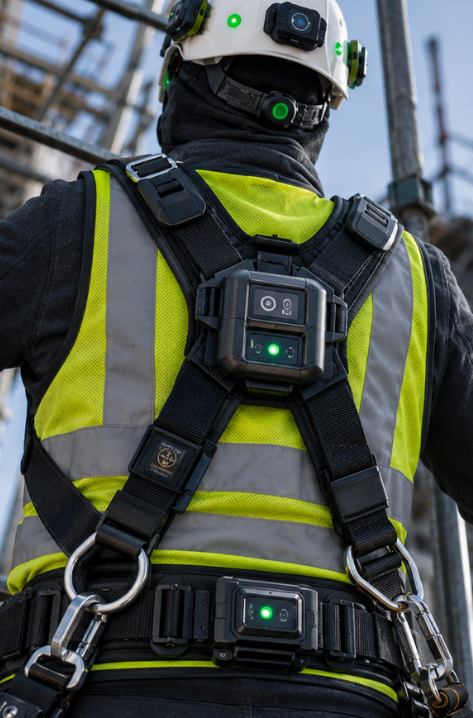
The use of wearable technology in the workplace is becoming increasingly widespread. This technology is primarily intended to improve productivity while enhancing occupational health and safety. Smart helmets, gloves, ID badges, belts, smart glasses, and wristbands are among the most common examples of such devices. These devices can collect and process a wide range of data, including an employee’s location, working height, body position, environmental data (such as temperature, pressure, noise and light levels, and air quality), and health-related data.[4]
Examples
In 2018, warehouse employees of Amazon, one of the world’s largest online retailers, began using smart wristbands designed to improve operational efficiency. Using ultrasound technology, these wristbands track employees’ hand movements in real time and guide them through small vibrations to help ensure that products are placed in the correct location.[5]
Another example is the Kinetic Reflex smart belt, which is designed to help prevent workplace accidents by improving employees’ posture. Used by major companies such as Coca-Cola and PepsiCo, the device monitors employees' posture in real time and alerts them through gentle vibrations when it detects high-risk working positions. The device also records employees’ activities and generates weekly reports to help identify workplace risks and highlight areas for improvement. According to the manufacturer, the smart belt can reduce workplace accidents by up to 60% and contributes to fostering a stronger workplace safety culture.[6]
Advantages and Disadvantages
The use of wearable technology in the workplace has the potential to increase productivity while helping to prevent workplace accidents and occupational diseases.[7] For example, a wearable device designed for employees working with hazardous chemicals may detect the presence of such chemicals, as well as environmental factors such as sudden changes in temperature, and alert the user accordingly. In certain circumstances, these alerts may be lifesaving. Over the long term, the adoption of such devices may also help foster a strong occupational health and safety culture within the workplace.
Wearable devices may also enable employers to exercise their managerial authority more effectively. By collecting more extensive and granular data on how work is performed, these devices provide employers with greater insight into workplace operations. As a result, business decisions can increasingly be based on data and may therefore become more informed and effective. However, to provide employers with a detailed picture of how work is carried out, wearable devices transform employees’ bodies into “sources of data”. Consequently, these devices also function as monitoring tools, enabling employers to track employees’ work pace, break periods, and the amount of time they spend in different locations within the workplace.[8]
While wearable technology is intended to improve workplace productivity, it may also have the opposite effect by creating a sense of constant surveillance among employees. Continuous monitoring is likely to have an adverse psychological impact on employees. In particular, the real-time transmission to the employer of information such as an employee’s location, whether the wearable device is being worn, and the duration of break periods may constitute a significant intrusion into the employee’s privacy. Moreover, this technology enables employers to monitor employees continuously, rather than relying solely on traditional methods such as performance evaluations or supervisors’ feedback. The data collected may also be used to create an employee “profile or performance score”. As a result, algorithmic decision-making may increasingly influence, or even determine, decisions regarding the continuation or termination of employment relationships.
The special categories of personal data or sensitive personal data collected through wearable devices may also give rise to discrimination. For example, by processing certain health-related data, an employer may use a wearable device to predict the likelihood that an employee will become pregnant and dismiss the employee before the pregnancy even occurs.[9] Similarly, devices that analyze employees’ emotional or mental state based on health data collected in real time may enable employers to identify and disadvantage employees who are perceived to be “more depressed.” At the same time, the technical reliability and accuracy of such analyses remain open to debate, particularly where they seek to assess subjective concepts such as “mood or emotional state”, which do not lend themselves to objective measurement.
Wearable Technology and Personal Data Protection
There is currently no legislation in Türkiye specifically governing wearable technology.[10] The use of wearable technology in the workplace should therefore be assessed within the broader legal framework governing the right to privacy and the protection of personal data.
Health Data
The types of data processed by wearable devices vary depending on the device and its functions. Some devices process users’ health data directly. Although information such as a user’s height, weight, daily step count, dietary habits, and physical activity may not constitute health data, it should be regarded as health data where it is processed for the purpose of assessing an individual’s health status or the risk of developing a disease.[11]
Under Article 6 of the Turkish Personal Data Protection Law No. 6698 (“Law”), health data constitutes a special category of personal data. As such, it may only be processed under the conditions expressly set out in the Law. The processing of employees’ health data through wearable devices is not expressly provided by law and is not necessary for the fulfilment of legal obligations relating to employment or occupational health and safety. Accordingly, where none of the other legal grounds for processing set out in the Law applies, such data may only be processed based on the employee’s explicit consent.
Location Data
Most wearable devices used in the workplace process employees’ location data. In particular, location tracking is often promoted as a key feature for employees working remotely or outside the employer’s premises. It is also considered particularly attractive in workplaces with a large workforce, where the employer's ability to exercise managerial authority may be more challenging.[12]
Unlike health data, location data is not classified as a special category of personal data. Accordingly, under Article 5 of the Law, it may, in principle, be processed without the data subject’s explicit consent where one of the legal grounds set out in the Law applies. However, it is difficult to conclude that the continuous, real-time processing of an employee’s location data falls within any of those legal grounds. Accordingly, as with health data, the processing of employees’ location data through wearable devices would require the employee’s explicit consent.
The Challenge of Explicit Consent
The Turkish Personal Data Protection Authority (“Authority”) and the higher courts approach employees’ explicit consent with caution. For explicit consent to be valid, it must be freely given and capable of being withdrawn. Both of these requirements may be undermined by the hierarchical nature of the employment relationship. For example, where an employer introduces the use of smart ID badges in the workplace, an employee’s consent can only be regarded as freely given if the employee has a genuine right to refuse to wear the device without being subjected to any pressure or adverse consequences. Furthermore, the “black box” nature of automated processing and wearable technology may also undermine the requirement that explicit consent be informed. Certain algorithms lack transparency in terms of their design or operation, and even where they are transparent, employees may not be able to understand how they function or the consequences of the processing.[13]
The Challenge of the Principle of Proportionality
Any processing of personal data must, in all circumstances, comply with the general principles set out in the Law. One of the principles particularly relevant in this context is that personal data must be processed for specified purposes and in a manner that is relevant, limited, and proportionate to those purposes. The principle of proportionality requires a reasonable balance between the intended purpose and the means used to achieve it. Accordingly, employers, as data controllers, should collect only the minimum amount of personal data necessary to achieve the intended purpose. Where the same objective can be achieved through less intrusive means, the use of a more intrusive method is likely to be regarded as disproportionate.
Once the employer’s purpose for using wearable technology has been identified, it should be assessed whether the same objective can be achieved through a device or system that requires the processing of less personal data. For example, while the objective of improving workplace productivity may be achieved through alternative methods without continuously monitoring multiple categories of employees’ health data, processing only the body position and working height data of an employee working on a hazardous construction site may be considered consistent with the principle of proportionality. Whether the principle of proportionality has been satisfied must ultimately be assessed on a case-by-case basis.
Guidance of the Authority
When assessing the use of wearable technology in employment relationships, it is useful to consider the Authority’s recent principle decision on the use of biometric data for attendance tracking (“Decision”)[14] and its public announcement on the use of camera systems in the workplace (“Announcement”)[15], particularly in relation to the requirements of explicit consent and the principle of proportionality. In the Decision, the Authority emphasized that, due to the imbalance of power inherent in the employment relationship, explicit consent does not constitute a sufficient legal basis for processing biometric data. It further noted that less intrusive alternatives to biometric data processing are available. Similarly, in the Announcement, the Authority concluded that purposes such as monitoring employees' attendance, discipline, or performance do not constitute legitimate grounds for workplace surveillance through camera systems. The Authority also stressed that, given the continuous nature of video recording and monitoring, employees retain a reasonable expectation of privacy even in the workplace. Accordingly, camera systems should not cover all areas of the workplace.
Conclusion
In light of the Authority’s recent approach, the use of wearable technology in the workplace for employee monitoring purposes—such as tracking performance or attendance or maintaining workplace discipline—does not, as a rule, appear to be lawful. Although employers may have a legitimate interest in pursuing these objectives, employees’ rights and freedoms are likely to prevail.[16]
Wearable technology also raises broader legal and practical concerns. These include the potential to generate big data, the risks of profiling and discrimination against data subjects, the challenges associated with securing wearable devices and the data they process, and the potentially significant consequences of unauthorized access to such data. Nevertheless, given its considerable benefits, wearable technology is expected to continue evolving and becoming more widely adopted. Accordingly, legal and technological developments in this area should be closely monitored.
References
(Only in Turkish) Principle Decision on the Processing of Biometric Data for Attendance Tracking Purposes. (2026, 06 02). Retrieved from Official Gazette: https://www.resmigazete.gov.tr/eskiler/2026/06/20260602-3.pdf
(Only in Turkish) Public Announcement on the Matters to Be Considered Regarding the Use of Security Camera Systems in Workplaces. (2026, 06 08). Retrieved from Personal Data Protection Authority: https://www.kvkk.gov.tr/Icerik/8770/is-yerlerinde-guvenlik-kamerasi-sistemi-kullaniminda-dikkat-edilecek-hususlara-dair-kamuoyu-duyurusu
(Only in Turkish) Wearable Technologies. (2020). Retrieved from Information and Communication Technologies Authority: https://www.btk.gov.tr/uploads/pages/arastirma-raporlari/giyilebilir-teknolojiler-arastirma-raporu.pdf
Alp, M., & Doğan, S. (Only in Turkish) Giyilebilir Teknolojiler ve İş İlişkisine Etkileri. Çalışma ve Toplum Dergisi, 4(71). Retrieved from https://dergipark.org.tr/tr/download/article-file/2576378
Arıcı Şirin, T. (2023). (Only in Turkish) İş Yönetimi ve Planlaması Çerçevesinde Kişisel Verilerin İşlenmesi. Kişisel Verilerin Korunmasına Uzman Bakış, Uzmanlık Tezleri Derleme Çalışması. Retrieved from Kişisel Verilerin Korunmasına Uzman Bakış, Uzmanlık Tezleri Derleme Çalışması.
Badur, E. (2025). (Only in Turkish) Giyilebilir Teknolojik Ürünler Aracılığıyla İşlenen Kişisel Sağlık Verilerinin Korunması. Türkiye Barolar Birliği Dergisi(179), pp. 309-344. Retrieved from https://medya.barobirlik.org.tr/tbbdergisi/App_Themes/Dergi/2025-179-2271.pdf
Dülger, M. V. (2019). (Only in Turkish) Kişisel Verilerin Korunması Hukuku (2 ed.). İstanbul.
Oğuz, Ö., & Tüzemen, C. M. (2025). (Only in Turkish) Yapay Zekanın İş Hukuğuna Etkisi. Galatasaray Üniversitesi Hukuk Fakültesi Dergisi(1). Retrieved from https://dosya2.gsu.edu.tr/page/2025/7/25/gsuhfd_c-24_s-1_haziran2025_dergi-son-457.pdf
Wearables in the Workplace: Using Wearable Technologies Under Federal Employment Discrimination Laws. Retrieved from U.S. Equal Employment Opportunity Commission: https://data.aclum.org/storage/2025/01/EOCC_www_eeoc_gov_wearables-workplace-using-wearable-technologies-under-federal-employment-discrimination-laws.pdf
Yılmaz, B. (2023). (Only in Turkish) Nesnelerin İnterneti (IoT) Uygulamalarında Kişisel Veri Güvenliği ve Mahremiyet. Kişisel Verilerin Korunmasına Uzman Bakış, Uzmanlık Tezleri Derleme Çalışması. Retrieved from https://www.kvkk.gov.tr/SharedFolderServer/CMSFiles/e21df2bb-b3
[9] (Wearables in the Workplace: Using Wearable Technologies Under Federal Employment Discrimination Laws, p. 4)
[14] ((Only in Turkish) Principle Decision on the Processing of Biometric Data for Attendance Tracking Purposes, 2026)
Related Insights
Explore further resources, articles, and valuable perspectives that delve deeper into related topics, offering you a broader understanding.
-
 Legal Alert 17.09.2026
Turkish Food Codex Regulation on Flavourings: A New Framework for the Food Sector Introduction
The new Regulation, published on 14 September 2026, comprehensively regulates the use, authorisation, production, labelling and notification requirements applicable to flavourings and food ingredients with flavouring properties. It introduces restrictions on source materials, limits on use and specific transitional provisions. Food business operators are required to review their products, supply chains, production processes and labelling practices and ensure compliance with the new requirements by 31 December 2026.
Read more > -
 Legal Alert 17.09.2026
Türk Gıda Kodeksi Aroma Vericiler Yönetmeliği: Gıda Sektörü İçin Yeni Çerçeve
14 Eylül 2026’da yayımlanan yeni Yönetmelik, aroma vericiler ve aroma özelliği taşıyan gıda bileşenlerinin kullanım, izin, üretim, etiketleme ve bildirim esaslarını kapsamlı biçimde düzenlemektedir. Düzenleme; kaynak materyal kısıtlamaları, kullanım limitleri ve özel geçiş kuralları getirmektedir. Gıda işletmelerinin ürün, tedarik, üretim ve etiket süreçlerini gözden geçirerek 31 Aralık 2026’ya kadar yeni hükümlere uyum sağlaması gerekmektedir.
Read more > -
 Legal Alert 16.09.2026
Deadline for Compliance with Minimum Capital Requirements in Joint Stock and Limited Liability Companies: 31 December 2026
Joint stock companies and limited liability companies are required to comply with the new minimum capital requirements determined under the TCC by 31 December 2026. Failure to complete the required capital increase within the prescribed period may result in such companies being deemed dissolved. Therefore, it is important for companies to review their capital structures and complete the necessary general assembly resolutions, amendments to the articles of association, and trade registry procedures in a timely manner.
Read more > -
 Legal Alert 16.09.2026
Anonim ve Limited Şirketlerde Asgari Sermaye Tutarına Uyum İçin Son Tarih: 31 Aralık 2026
Anonim ve limited şirketlerin, TTK kapsamında belirlenen yeni asgari sermaye tutarlarına 31 Aralık 2026 tarihine kadar uyum sağlamaları gerekmektedir. Süresi içinde sermaye artırımı yapılmaması halinde şirketler infisah etmiş sayılabilecektir. Bu nedenle şirketlerin sermaye yapılarını kontrol ederek gerekli genel kurul, esas sözleşme değişikliği ve ticaret sicili işlemlerini zamanında tamamlamaları önem arz etmektedir.
Read more >